Showing posts with label getty. Show all posts

Thursday, May 12, 2011

I Love LA(CMA)


There’s a joke: What is the difference between Los Angeles and Yogurt? Yogurt has culture.

This vast sprawling city has its faults (poor public transportation), but one thing we are not lacking in is culture. We have amazing talent oozing from every corner of our extremely diverse population. I am convinced that you can find ANYTHING in Los Angeles if you try. Our problem is not that we’re vapid and culture-less drones obsessed with fame and glory. Our problem is that we are too unwieldy to navigate.

There is one institution in particular that I would like to highlight as consistently showing that they are committed to providing Los Angeles with premier Art and Cultural experiences: Los Angeles County Museum of Art (LACMA). Over the years I have watched this institution grow its campus and art collection aggressively and thoughtfully; expanding on contemporary and non-western arts to appeal to its young and diverse community. With its expanding campus and art acquisitions, people around the globe have taken notice. Earlier this year Los Angeles was given the prestigious honor of acquiring the highly coveted Robert Mapplethorpe archive as a joint ownership with The Getty (another secret weapon in the L.A. arts & culture arsenal).

Aside from the expansions, LACMA has remained committed to providing art experiences for the people of Los Angeles by providing many opportunities for free admission. That’s right, I said FREE! Here’s a rundown:

Free Admission with Membership

Members receive unlimited free general admission to the permanent galleries and non-ticketed exhibitions for two adults and for their children under 18.

**Pay attention Parents!** The NexGen program is set up so that all children who sign up are given a free membership to LACMA that lasts until they turn 18. NexGen members receive unlimited free general admission to the permanent galleries and non-ticketed exhibitions PLUS one adult guest. (This is great for families of four. Everyone gets in for free!)

Free Admission Second Tuesdays

On the second Tuesday of each month, general admission to the permanent galleries and non-ticketed exhibitions is free to all.

Free Admission for LA County Residents After 5

After 5 pm on Monday, Tuesday, Thursday, and Friday (the museum is closed Wednesdays) general admission to the permanent galleries and non-ticketed exhibitions is free to Los Angeles County residents with proof of residency.

Free Holiday Mondays (sponsored by Target)

Target sponsors several free-admission days throughout the year at LACMA. They feature special programming and free general admission to the permanent galleries and non-ticketed exhibitions.

Whew! And if that weren’t enough, LACMA has tons of free events (music, family days, films, etc.) throughout the year. It’s always a great idea to look at the calendar and see what’s happening. They are very good about communicating via social networking and maintaining a consistent blog rich with the inner-workings of the establishment. Making the whole museum much more accessible, even if you are reading about what’s happening from my home a 30 minute freeway ride away.

I love (almost) every major art museum in L.A., but I hold a special place in my heart for this particular museum. So, thank you LACMA bringing more culture to Los Angeles than any cup of yogurt I’ve ever eaten.

Wednesday, March 11, 2009

From the Archives: Rembrandt


Rembrandt’s Late Religious Portraits
The J. Paul Getty Museum 2005


I arrived at the J. Paul Getty Museum, Los Angeles around noon on a Sunday. The air was clear from the mountain top facility and a cool summer breeze swept across the grounds. With a six-year-old clutching my right hand and an infant strapped to my chest, I ascended the glistening marble staircase toward the third floor exhibition room that held the late religious paintings of Rembrandt van Rijn.

Rembrandt is one of the world’s most renowned painters. He was and remains to be an inspiration to artists with his use of color and blending. I have read that Rembrandt studied and mastered chiaroscuro, the Italian method of modeling light and dark paints to give artwork tridimensionality. His paintings of life in 17th century Amsterdam and his famous portraiture were said to be luxurious; his brush strokes bold and elegant, his use of color astounding, and his ability to render depth of emotion in his subject matter unparalleled. On paper, Rembrandt was truly a master, in person, he was simply breathtaking.

I stepped into a red room that housed 16 portraits, and was awe-struck. I may have seen these images in textbooks or postcards. I may have read of Rembrandt’s mastery and yet, as I stood before it I was dumbfounded. I approached each painting and breathed heavily. I could taste the linseed oil in the back of my throat and I felt as though I was devouring genius.

My eldest daughter fiddled with her audio tour and found most images to be only slightly interesting, that is, until we came upon Christ. The portrait of Christ with brown hair and beard was a more conventional image of Christ, but the eyes were arresting. His skin was painted with light, rich colors that caused his face to glow. The broad strokes of reds and brown in his hair complimented the fine detailed lines of grey in his eyes. Rembrandt had captured a depth of emotion in his masterful strokes. There was an intensity, yet a gentleness in the eyes of Rembrandt’s Christ that made an impression on even the youngest of viewers. The use of dark neutral colors and subtle blending around the figure made the bold, bright flesh of Christ glow like hot embers in a dark fireplace. Christ appeared very human. Unlike many other images of Jesus, this one seemed to be grounded in reality. Christ looked as though he were living, breathing flesh; a person that one could touch.

As we stood silently admiring the portrait of Christ, I noticed some discoloration. At first, I thought that at some point in time something had spilled on the painting, or perhaps it was once hung in an oval frame, or it may have been an effect, such as a halo, to illuminate this religious icon. However none of these scenarios seemed right, the discoloration and distortion created a jagged oval around the center of the painting and Rembrandt hadn’t used effects to illuminate heavenly figures in any other painting on display. I consulted the little pamphlet I was handed upon entering the exhibit, “… the central portion of the image was cut away and removed by thieves and later reattached.” Mystery solved.

My daughters and I slowly viewed the rest of the exhibit. One of the last images we saw was a portrait of Hendrickje Stoffels, Possibly As the Sorrowing Virgin. This work seemed to glow more than any other in the room. The warm yellows and pinks in her face contrasted with the cool green and muddy violets in the shadows of her chin. Rembrandt had also done something bold, it appears as though he took the end of a bristle brush with a dab of bright red and lightly tapped it on the apple of her cheek to cause a slight blush. He rendered her dark, ebony eyes to radiate intelligence and sadness.

Although the portrait of Hendrickje Stoffels was listed as possibly being the sorrowing Virgin, I couldn’t help but wonder if she may have been a depiction of Mary Magdalene. I have seen many prints of historical portrayals of Mary Magdalene in similar poses, garments and facial expressions. Both the Virgin Mary and Mary Magdalene have been depicted throughout art history as being melancholy women who carry the weight of divine love upon their delicate shoulders. Another reason the portrait reminded me of Mary Magdalene was because of the model’s costume of furs, and gold in her hair. Usually Mary Magdalene is shown wearing jewelry or flashy clothing to depict her former life as a prostitute, while the Virgin is usually shown as being simple and pure, untainted by materialism. Regardless of which Mary this portrait was intended to be, it was a magnificent, realistic, and stirring work of art.

My overall feeling about this exhibit is that Christian icons have never looked so human, so approachable. They seemed as though they had lives and secrets beyond the stories that are written. The sheer beauty of these artworks moved me deeply. Not only did I want to meet the men and women depicted in these sixteen canvases, but I wanted to meet the man who could breathe life into oil and pigments.

Monday, February 16, 2009

Adventures in Art: The Getty Drawing Hour - February


Sunday I waited in a 35 min. line of cars into a parking structure. $10 to park to visit The Getty Center. The iconic museum on the hillside. The most wealthy art establishment in the world, and the collection of the estate of oil barron, J. Paul Getty. Not only are the views of Los Angeles breathtaking. But the architecture and artifacts are some of the worlds greatest treasures.

I have been taking advantage of a structured monthly drawing lesson they offer for free entitled The Getty Drawing Hour. So far it has been a fun refresher course for me. Since I will be not attending school until Fall, I thought it best if I did something in the meantime to keep my drawing "chops" up.

The Getty Drawing Hour theme for the month of February has been Gesture Drawing. Gesture is generally used as a warm up or a way to get the overall action or expression of a piece down in a short amount of time. Or it can be extended and layered upon to create a more in depth study. For this particular session none of our drawing extended beyond a 15 minute study. Instead of using models and/or live studies as is the standard for most art classes, we got to draw from the Getty's exquisite European Renaissance gallery.

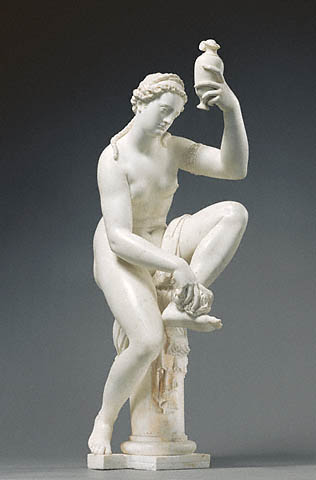
The one piece I kept coming back to was the lovely sculpture Female Figure by Giambologna, Florence, Italy 1571 - 1573. Although it was easy to be seduced by the lucious colors of Titian, or the melancholy angles of El Greco, it was the subtle light and shadow that played upon the lovingly carved marble that caught my fancy. I plopped down on the floor and spent a few precious minutes beneath her. Gesture drawing and building up layers. An exercise in structured freedom.

It was so nice to be in class again.